
Colin Chapman was a pioneer in using struts as a rear suspension system. Even today, rear struts are referred to as Chapman struts, while very similar front suspension struts are called MacPherson struts, which were invented a decade earlier in 1949.
Chapman's next significant breakthrough was popularising monocoque chassis construction in automobile racing with the innovative 1962 Lotus 25 Formula One car. This method produced a body that was both lighter and stronger, while also enhancing driver safety during crashes. Although this concept had seen limited use in motorsport before, the first vehicle to feature a monocoque chassis was the 1922 Lancia Lambda road car. Lotus was an early adopter of this technology with the 1958 Lotus Elite, which had a modified monocoque body made from fibreglass.
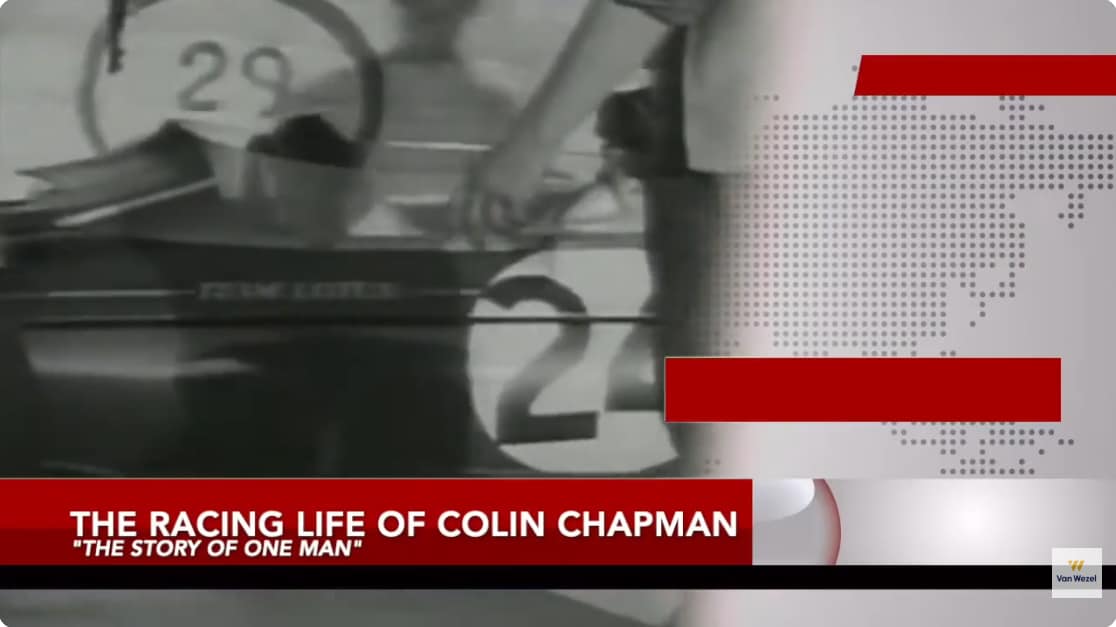
When American Formula One driver Dan Gurney saw the Lotus 25 at the Dutch Grand Prix in Zandvoort, he was so impressed by its advanced design that he invited Chapman to the 1962 Indianapolis 500. Gurney made his Indy debut driving a space-frame rear-engined car designed by John Crosthwaite, who had previously worked with Chapman, and built by American hot-rodder Mickey Thompson. After the race, Chapman proposed to Ford Motor Company an aluminium monocoque Indy car powered by a 4.2-litre aluminium V-8 Ford passenger car engine. Ford accepted, and the Lotus 29 debuted at Indianapolis in 1963, with Jim Clark finishing second. This design soon replaced the long-standing tube-frame chassis formula in racing cars. Although materials have evolved from sheet aluminium to carbon fibre, this approach remains the standard for constructing top-level racing cars today.
Inspired by Jim Hall, Chapman was among the pioneers who introduced aerodynamics into Formula One car design. Lotus applied the concept of positive aerodynamic downforce by adding wings at a Tasman Formula race in early 1968, although Ferrari and Brabham were the first to use wings in a Formula One race at the 1968 Belgian Grand Prix. Early wings, in 1968 and 1969, were mounted about 3 feet (0.91 m) above the car to operate in ‘clean air’—air undisturbed by the car's passage. However, the initially under-designed wings and struts often failed, leading the FIA to mandate that wing mounting hardware be attached directly to the sprung chassis. Chapman also pioneered relocating radiators from the front to the sides of the car to reduce frontal area (thus lowering aerodynamic drag) and to centralise weight distribution.
Chapman was also innovative in the commercial side of racing. He was among the first Formula One entrants to turn their cars into moving advertisements for non-automotive products, initially with cigarette brands Gold Leaf and, most famously, John Player Special.
Working with Tony Rudd and Peter Wright, Chapman pioneered the first use of "ground effect" in Formula One, where venturis created a low-pressure area under the car, generating suction (downforce) that held the car firmly to the road during cornering. Early designs used sliding "skirts" that contacted the ground to isolate this low-pressure zone.
Chapman and his lead driver Mario Andretti, pictured during their double World Championship-winning 1978 season with the ground effect Lotus 79, next developed a car that generated all its downforce through ground effect, eliminating the need for wings and their drag. The Lotus 79 dominated the 1978 championship. However, skirts were eventually banned because they were vulnerable to damage, such as from kerbs, which caused loss of downforce and car instability. The FIA moved to eliminate ground effect in Formula One by raising the minimum ride height from 1981 and requiring flat-bottom cars from 1983. Designers have since regained much of the lost downforce through other means, aided by extensive wind tunnel testing.
One of Chapman's final major technical innovations was the dual-chassis Formula One car, the Lotus 88, introduced in 1981. For ground effect to work efficiently, aerodynamic surfaces had to be precisely positioned, requiring a very stiffly sprung chassis, which was harsh on drivers and caused fatigue. To address this, Chapman designed a car with two chassis: one softly sprung chassis for the driver’s comfort, and a stiffly sprung chassis where the skirts and aerodynamic elements were mounted.
Source: https://www.youtube.com/watch?v=7gguhPZOkqY
Source: https://www.youtube.com/watch?v=7gguhPZOkqY
