
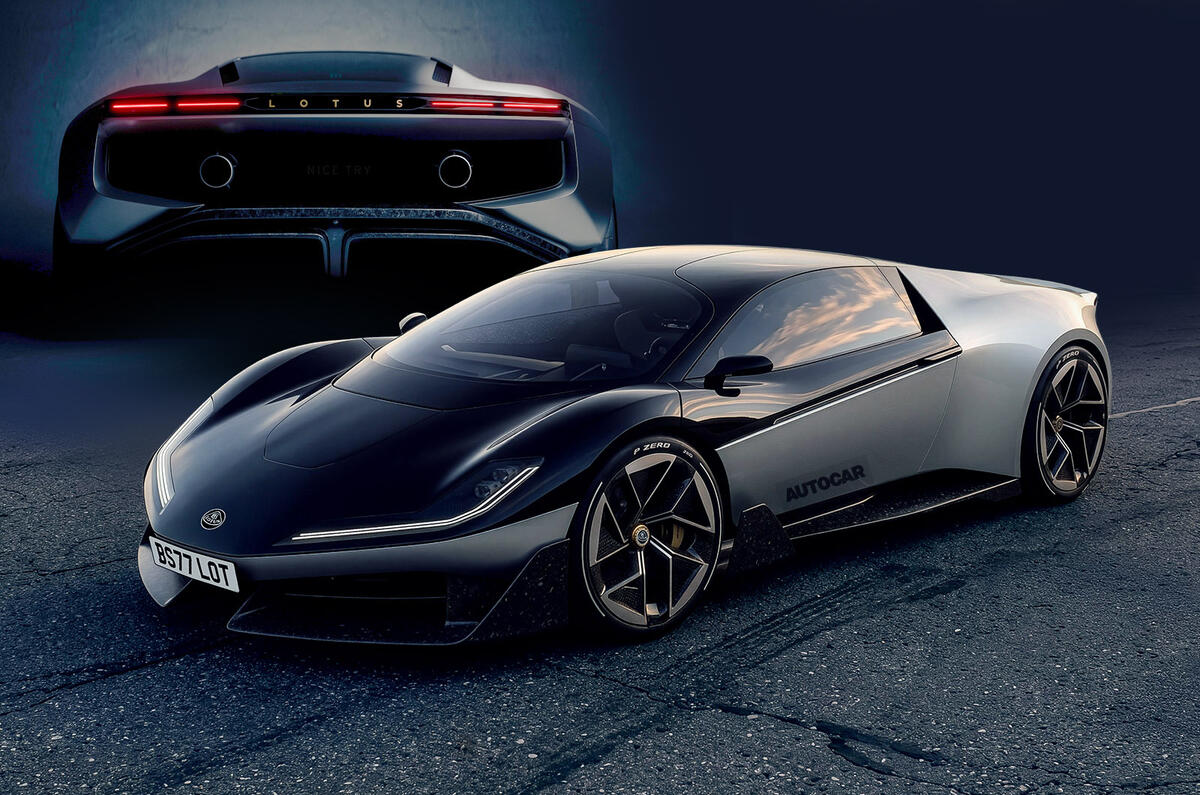
Lotus will re‑enter the ICE supercar arena in 2028 with a new hybrid V8 flagship, expected to revive the Esprit name and target rivals such as the Ferrari 849 Testarossa.
The car will use a hybrid system built around an all‑new V8 developed by Horse, the Renault‑Geely powertrain division. Lotus has confirmed that total output will exceed 986bhp. Production will take place at Hethel alongside the Emira, reinforcing the brand’s long‑standing Norfolk base.
This model marks a major shift in Lotus’s strategy. After abandoning its plan to go fully electric by 2028, the company is repositioning ICE sports cars as a core part of its future lineup.
Internally codenamed Esprit, the new supercar draws heavily from the 2024 Theory 1 electric concept. A teaser image of the rear shows clear visual links to the concept, now complemented by two enormous exhaust outlets.
Lotus and Horse have been co‑developing the turbocharged V8 with a focus on achieving a class‑leading power‑to‑weight ratio. CEO Feng Qingfeng said the clean‑sheet design allows significant reductions in engine size and mass. The V8 will also be shared with an undisclosed Geely brand for a future off‑roader to improve economies of scale.
To keep weight down, the car will use a hybrid rather than a plug‑in hybrid system, bucking the trend set by models like the Aston Martin Valhalla, Lamborghini Temerario and Ferrari 296 GTB. Eliminating plug‑in hardware allows for a smaller battery and fewer charging components.
Design chief Ben Payne confirmed that the Theory 1 strongly influences the production model and that the Esprit name is under serious consideration. The original Esprit ended production in 2004 with a V8, and Payne noted that customers have long asked for its return.
A three‑seat, McLaren F1‑style layout—as seen in the Theory 1—remains a possibility. Feng said that a central driving position could simplify global production by eliminating the need for separate LHD and RHD versions.
The 4490mm Theory 1 was conceived as an accessible supercar rather than a hypercar like the 2011bhp Evija, using a carbonfibre tub to keep weight down. Lotus previously said that 85% of the concept’s technology was production‑ready.
The V8 supercar forms part of Lotus’s new mixed‑powertrain strategy. Feng said the global market no longer supports a single propulsion solution, and that luxury buyers still value the visceral feel of large combustion engines over the smoothness of EVs. Geely’s original plan for Lotus to go all‑electric by 2028 was dropped in 2024 after slower‑than‑expected customer adoption.
The new model carries the internal designation Type 135, a name once reserved for a cancelled electric Emira successor. The Emira itself will continue, receiving a major update next year that will deliver the most powerful and lightest version yet. It will later adopt a new V6 from Horse before the decade ends.
Under Lotus’s revised plan, sports cars will make up a third of its targeted 30,000 annual sales, up from 6520 last year. With the Evija still being hand‑built at Hethel in tiny numbers, the new “Esprit” will become the brand’s halo ICE model.
Pricing has not been announced, but Feng’s comparison to the Ferrari 849 Testarossa suggests a starting figure close to £407,617.
Source: https://www.autocar.co.uk/car-news/new-cars/new-2028-lotus-esprit-supercar-use-986bhp-plus-hybrid-v8
