
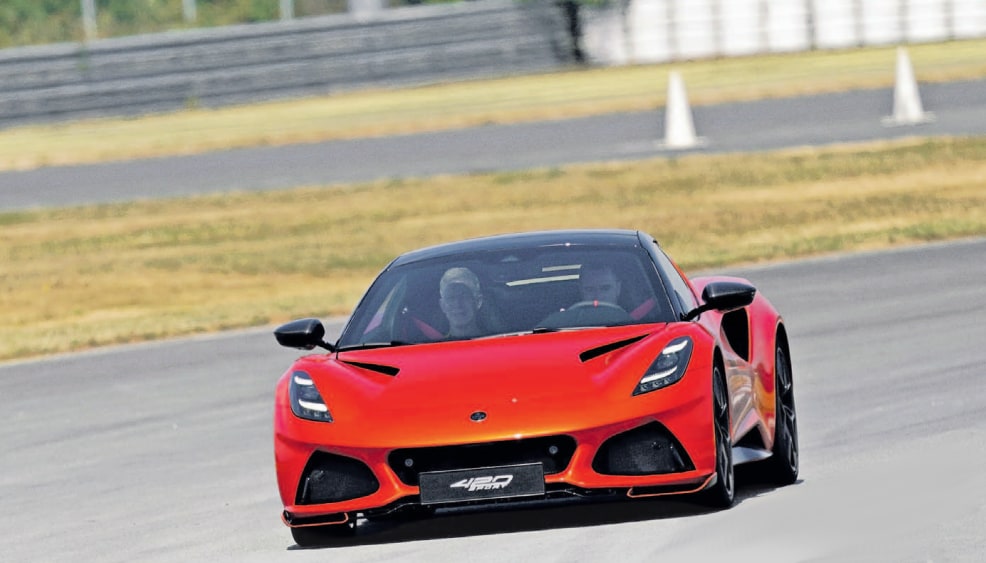
I apologize if what follows seems somewhat vague. My aim is to put a name to the joy I experienced last week while testing the Lotus Emira 420 Sport at the company’s test track in East Anglia, England. I’m certain the scientific explanation involves ecstatic brain chemicals, causing an overactive smile reflex. Perhaps I wasn’t hugged enough as a child, because these G-forces felt like affection. Regardless, it’s about physical connection and intimacy. It’s about the fact that the Lotus’s polar axis aligns exactly with the driver’s inboard hip, so the car rotates around them rather than an off-center pivot point. The Lotus places you in Mach’s bucket seat, the center of the universe.
The joy-buzzer energy comes through your palms via the rack-and-pinion steering, with the wheel gaining weight and Braille-like sensitivity as cornering forces and slip angles increase. The steering hydraulics gently reduce kickback at full lock. Despite their adjustability, electrically assisted power steering systems feel like a Ouija planchette. I’m looking at you, Ferrari.
Fresh from a midlife update, the mid-engine, two-seat Emira offers a choice of powertrains, each with its own charms. For drivers who prefer manual control, the supercharged 3.5-litre V6 (406 hp) pairs with a six-speed manual transmission. The car I drove, the 420 Sport, features a Mercedes-AMG-supplied 2.0-litre turbo-four engine and an eight-speed dual-clutch automated transaxle, controlled by beautifully weighted shift paddles behind the steering wheel.
Ring-a-ding-ding. Bang bang bang. Lotus claims the 420 Sport is the fastest production four-cylinder in the world, accelerating from 0-60 mph in 3.7 seconds with a top speed of 186 mph. The upgrade includes enhanced air-inlet shrouds on the sides and louvered panels on the front wings, supposedly to help release air pressure at high speeds. If I were configuring a car for myself, I’d opt to delete those.
After a couple of laps in the eager and edgy 420 Sport, I realized how long it had been since I’d truly had fun—that’s the word!—in a sports car. That’s because Lotus is the only production carmaker that genuinely embraces sliding. Other sports car manufacturers keep their customers firmly planted on the road with complex traction and stability systems that intervene if the computer detects loss of traction or control. For Lotus, that moment is precisely the point. The excitement of these lively lightweights is pushing them to, and maintaining them at, the immediate limits of the tires—sawing at the wheel, accelerating hard, pitching and catching. For these cars and engineers, the Blue Bird of Happiness sounds like a squawking flock of Michelins.
Lotus refers to this as the “envelope of progressivity,” defining how predictably and pleasantly a car will pivot under braking and throttle without spinning out. The 420 Sport’s wicked sashay results from careful calculations: a 40/60 rearward weight distribution; a 101.2-inch wheelbase; and an open rear differential delivering 369 lb-ft of engine torque to the road, albeit sometimes unevenly. Praise is also due to the custom-compounded Michelin Pilot Sport Cup 2 tires, which have a broad sweet spot.
Behind all this is the 420 Sport’s greatest advantage: it weighs just 3,153 pounds (with the Lightweight Handling pack). By comparison, a Corvette Z06—a competitor in the mid-engine sports car category—weighs around 350 pounds more. The Z06 is many things, but not “toss able.”
Sixty years ago, race engineer Colin Chapman moved Lotus Cars to Hethel, England, converting a nearby World War II airfield into a test circuit. His mantra was “Add lightness.” Chapman built a series of brilliant sports cars, won many Formula One championships, and lost millions in investments before his death in 1982. In 2017, the Chinese conglomerate Geely acquired a controlling interest in the company.
You might remember Lotus’s bestselling car, the Mazda Miata (1989). When Mazda decided to build a British-style roadster, it lovingly copied the ’60s-era Lotus Elan. The runway-turned-test track was refurbished in 2011 with a new layout, fresh asphalt, and safety barriers, now featuring two perfectly constant-radius 180-degree turns: the hairpins of destiny.
With a nervous Lotus driving instructor as my passenger, I was determined to perform a flawless drift through the corner—a maneuver I had never successfully completed in other cars or locations. I entered fast, at the top of second gear, eased the throttle, flicked the steering wheel (more like gesturing “that way”), and got back on the gas. Then, a miracle: the car rotated—surely and predictably—into a tail-out position, as easily as it went straight. It didn’t spin or resist. I managed to hold this balance, sliding and sidestepping on the throttle until I had to return to the main straight. On another lap, I even upshifted from second to third gear without losing the drift, swinging wide at the track edge, trailing clouds of glory.
Ironically, Lotus’s traditional approach to cornering and traction—crossed up, tail out, mustaches ablaze—resembles what is now called drifting. Lotus plans to continue building all its internal combustion engine sports cars at the Hethel facility, the brand’s emotional home. At this rate, Hethel could keep producing piston-powered sports cars for many years.
That sounds like good news, right? The U.S. market isn’t exactly overflowing with charismatic mid-engine sports cars. Last year, Porsche ended production of its excellent 718 (Cayman and Boxster) series, removing the Emira’s closest competitor. However, Lotus officials quietly worry about potential tariffs on European imports and restrictions on Chinese software that might disrupt their U.S. business plans. It remains uncertain whether the Trump administration will allow Lotus to continue unimpeded.
