
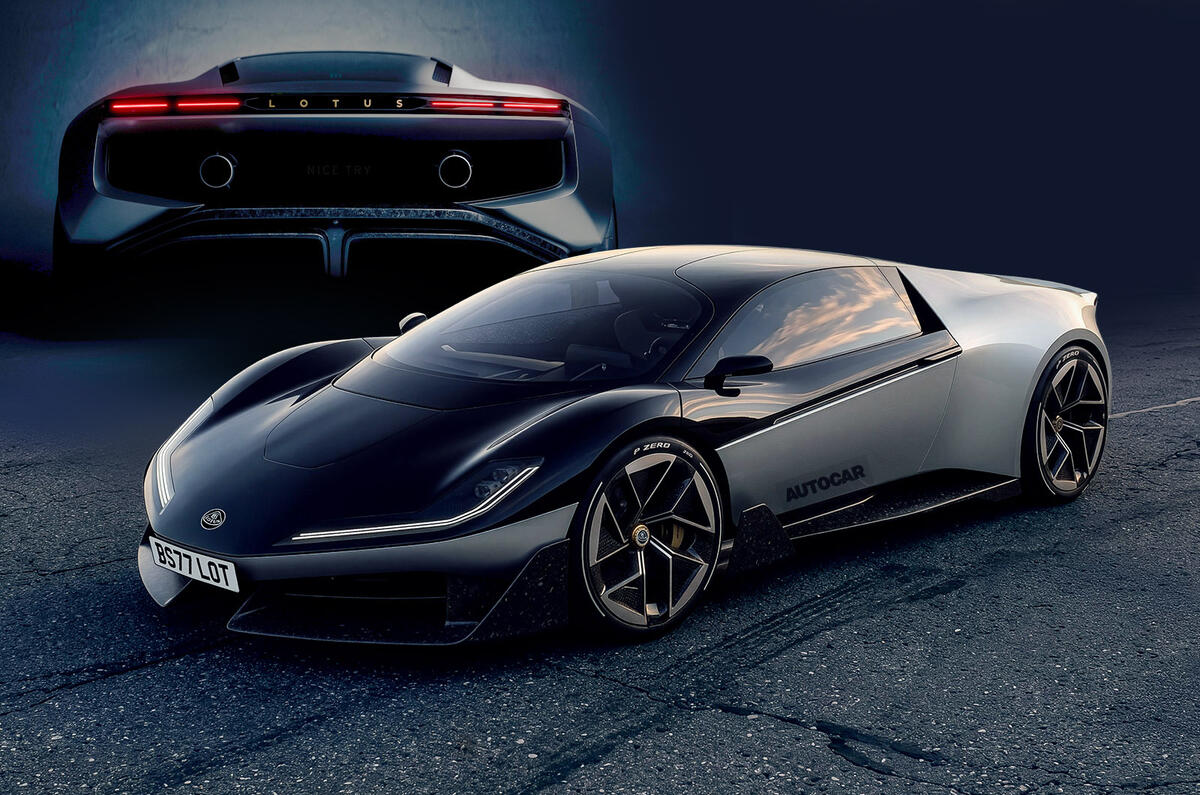
Lotus will introduce a V6 version of the new Esprit supercar alongside the already confirmed hybrid V8, as part of the company’s commitment to maintaining the brand’s lightweight philosophy, according to the CEO.
Lotus CEO Feng Qingfeng informed investors during the company’s second-quarter earnings call on 27 August that the V8 variant, codenamed Type 135 and scheduled for release in 2028, aims for a target weight of 1.5 tonnes.
Feng explained that the hybrid powertrain enables compliance with global emissions standards while retaining the core Lotus DNA of lightweight design and highly focused driving dynamics.
Previously, Lotus announced that the Emira sports car replacement would feature a V6 hybrid, but this is the first confirmation that the same drivetrain will be used in the Esprit flagship, offering a lighter model with a more accessible price point.
Both the V6 and V8 engines are being developed by Horse, a joint venture between Lotus’s parent company Geely and Renault.
Feng acknowledged the difficulty of keeping weight low in a complex electrified drivetrain, stating, “Achieving that target with an 800V architecture, a hybrid system, a V8 engine and electric motor in [the car] just is not easy.”
One approach involves an ultra-lightweight electric motor. Feng noted, “A typical 150kW [201bhp] motor weighs between 75kg and 95kg. We have leveraged Formula 1 technology to reduce it to just 20kg.”
Lotus states the total peak power output will exceed 1000bhp.
The vehicle will feature an eight-speed dual-clutch gearbox designed to handle high torque while minimizing weight, Feng added.
The Esprit will serve as a flagship model, combining Lotus’s electric expertise with its strategic return to combustion engines, beginning with the Eletre X plug-in hybrid version of the originally electric-only SUV set to launch in the UK next year.
Feng said, “The Type 135 will bridge the gap between the Emira and Evija, maintaining the emotional connection Emira owners have with Lotus’s mechanical handling while leveraging V8 hybrid technology to approach the technical benchmark set by the Evija.”
The new supercar will be produced alongside the Lotus Emira sports car at Hethel, reinforcing Lotus’s historic base in Norfolk.
This aligns with a broader plan to focus on internal combustion engine (ICE) sports cars after abandoning the goal to become fully electric by 2028.
The new Esprit draws inspiration from the 2024 Theory 1 electric supercar concept. A preview image of the production car’s rear released by Lotus reveals a strong resemblance to the concept, with the addition of two large exhaust pipes.
Lotus has collaborated with Horse on developing the turbocharged V8, which is expected to set a new standard in power-to-weight ratios.
Feng stated earlier this year, “Since we are starting from scratch with this engine, we will put significant effort into improving both the volume and weight of the engine.”
The engine will also be used by an as-yet-unnamed Geely brand for a V8-powered off-roader, enhancing economies of scale, according to Feng.
The new supercar will be a hybrid rather than a plug-in hybrid to save weight, diverging from the recent trend of PHEV drivetrains in supercars like the Aston Martin Valhalla, Lamborghini Temerario, and Ferrari 296 GTB. Eliminating the need to plug in for charging allows Lotus to reduce battery size and avoid installing charging components.
Lotus’s head of design, Ben Payne, told Autocar that the new supercar will be influenced by the Theory 1, stating, “Concepts are created to gauge reactions and provide a future direction, and [the Theory 1] was very well received.”
While the Esprit name has not been officially confirmed, Payne indicated it remains a strong possibility.
He said, “When the Esprit ended production in 2004, it featured a V8 engine, and many customers have wanted it to return ever since. It remains in the hearts and minds of many of our customers.”
The production model might adopt the McLaren F1-style three-seat layout seen in the Theory 1.
Feng commented, “That could be an option because previously, separate left-hand and right-hand drive versions were needed, but placing the driver in the centre removes that requirement.”
The 4490mm-long Theory 1 was designed as an accessible supercar rather than a hypercar like the extreme 2011bhp electric Lotus Evija. For example, weight was reduced by using a carbon fibre tub.
At the time, Lotus stated that 85% of the technology shown in the model was production-ready.
The supercar is part of Lotus’s broader shift toward a mixed powertrain strategy. Feng noted that, considering current global market trends, “there should not be a single solution when it comes to power; the power solution should be diversified.”
Geely’s original plan for Lotus was to transition to electric vehicles only by 2028, but this was abandoned in 2024 after customer adoption proved more challenging than expected.
“In the luxury segment, customers enjoy the thrill of driving cars with powerful large engines,” Feng said. “They tend not to prefer the smoothness of EVs.”
The new supercar’s internal model name is Type 135, previously reserved for the cancelled electric sports car intended to replace the Emira.
The internal combustion engine Emira will continue, first receiving a significant update next year that promises “the most powerful and lightest Emira built,” followed by a further overhaul adopting the Horse V6 engine; this model is expected before the decade’s end.
Under Lotus’s new strategy, sports cars will represent one-third of its targeted 30,000 annual sales, up from 6,520 sales last year.
With the Evija still being produced at Hethel at about eight to ten units per year, the Esprit will take over as the ICE halo model.
No pricing has been announced, but Feng identified the Ferrari 849 Testarossa as the main competitor, suggesting a price near Ferrari’s entry point of £407,617.
